

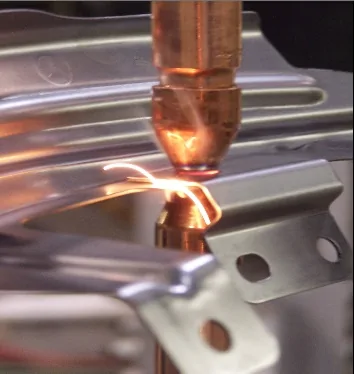
Contact welding
6430
04.01.2018
Contact welding This process involves heating the metal with an electric current and then causing plastic deformation in the joint zone through compression. It is classified as pressure welding. The first mentions of this type of welding date back to 1856, when the English physicist William Thomson used butt welding. Its application contact welding Found in the aviation and mechanical engineering industries. There are several types of this type of welding:
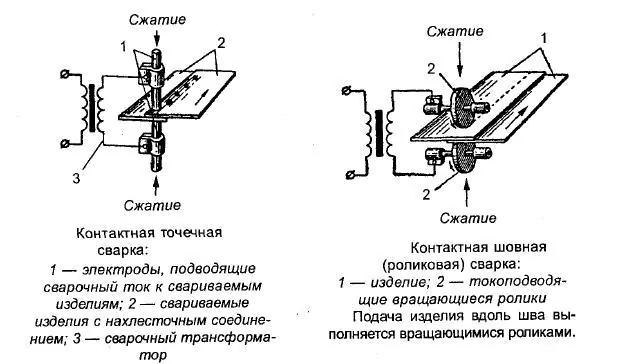
- contact spot welding;
- relief welding;
- contact seam welding;
- butt;
- pulse welding.
Each of these types of contact welding has its own characteristics, suited to specific metal joining processes. However, the welding processes themselves are essentially the same. Contact welding It is so popular that approximately 30% of all welding work is done using this type of welding and this percentage is currently increasing.
Contact welding technology
Surface preparation of the metal is a special requirement for a strong welded joint. When performing this step contact welding technology will proceed successfully and efficiently. Surface requirements:
- degreased, without oxide films;
- ensure minimal contact resistance between the electrode and the component;
- The resistance may be the same across the entire contact area if the circuit is part-to-part;
- The surfaces to be welded must be smooth.
Although there are different types of contact welding, contact welding technology is as follows:
- The part is clamped in the electrodes of the welding machine;
- Connecting electrodes to a transformer and passing a high-power electric current;
- Strong heating of the welding area and crystallization of molten metals occurs;
- After removing the current pulse, allow the cooling time to pass.
Advantages of this type of welding:
- high-performance welding process;
- technical and economic efficiency;
- ease of automation of this process and robotization;
- high quality connections;
- The technological process is environmentally friendly.
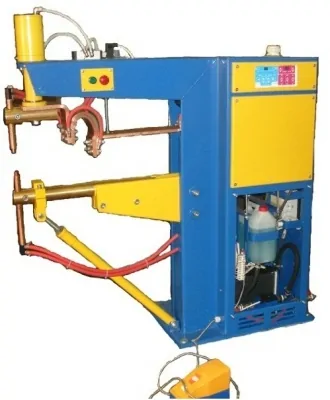
Spot welding machine
Spot welding machine Thanks to its functional features, high-tech welding processes are possible. Specifically, machines are increasingly being manufactured with microprocessor control units. These units enable welding complex configurations with varying current parameters. They also control transient processes in the welding zone, influencing the process during the welding pulse.
Spot welding machine The MT-2202-1 is very popular and in demand. It is versatile and adaptable to new tasks, and features a wear-resistant, high-hardness electrode made from BrKhTsR (BrKhTsR) material from German manufacturers. It incorporates an RKSM microprocessor unit with a simple interface and reliability. This machine is designed for AC welding with constant compression force, using either multiple pulses or a single pulse. It welds parts made of carbon steel, alloy steel, heat-resistant steel, and corrosion-resistant steel. It also easily joins non-ferrous alloys such as brass, titanium, and aluminum. Spot welding machine The MSh-2201 is designed for electric resistance seam welding. It joins longitudinal, high-strength seams of low-carbon and stainless steel. This machine offers high productivity and clean seam quality.
 EN
EN  RU
RU  UK
UK  DE
DE  ES
ES  HI
HI  IT
IT  PT
PT  FR
FR  ZH
ZH